
A data governance maturity model measures how systematically an organization manages its data — from ad-hoc heroics to optimized, continuously improving practice — and turns that measurement into a roadmap. Assessing maturity honestly is the first act of every governance program that ends up working.
I’ve lived this journey from the inside: standing up data governance and stewardship at the Department of Veterans Affairs meant moving a very large organization up exactly this curve, level by unglamorous level. The pattern I saw there repeats everywhere — the hard part isn’t knowing what Level 5 looks like, it’s being honest about which level you’re actually on, and picking the two or three disciplines to advance next rather than trying to mature everything at once.
The Importance of Data Governance Maturity
Establishing a robust data governance program is crucial for organizations to:
- Ensure data quality and accuracy
- Facilitate compliance with data protection regulations
- Enhance data security and privacy
- Improve data-driven decision-making
By assessing data governance maturity, organizations can identify areas for improvement, set goals, and establish a roadmap for achieving a higher level of maturity.
The Five Levels of the Data Governance Maturity Model
Nearly every published maturity model — DAMA’s, CMMI’s, the vendor frameworks — shares the same five-level shape, inherited from the original CMM for software. The names shift between publications; the underlying progression doesn’t.
| Level | Name | Hallmarks | You’ve outgrown it when… |
|---|---|---|---|
| 1 | Initial | Ad hoc, dependent on individual heroes; no documented policies | Any repeatable process exists on paper |
| 2 | Managed | Pockets of process in specific teams or projects; inconsistent across the org | Policies and roles are standardized enterprise-wide |
| 3 | Defined | Documented policies, named stewards, an operating council | Metrics, not opinions, drive governance decisions |
| 4 | Measured | Quality and compliance are quantified, reviewed, and acted on | Improvement is continuous and self-sustaining |
| 5 | Optimized | Governance is embedded in culture and adapts ahead of business change | (You maintain it — nobody graduates) |
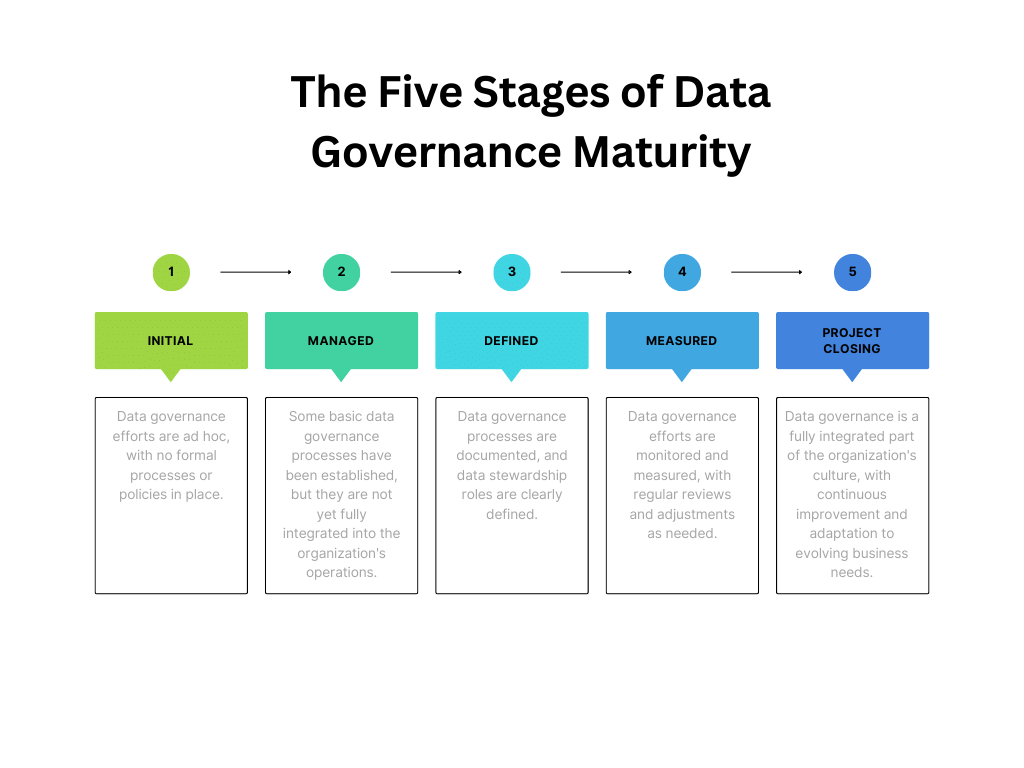
What each level actually looks like in practice:
Level 1 — Initial. Data problems are solved by whoever notices them. Definitions live in people’s heads; the same metric has three values in three reports and reconciling them is somebody’s side project. There is no policy to violate because there is no policy. Most organizations honestly assessed start here, including ones with governance tools already purchased.
Level 2 — Managed. A team or a project has written things down — usually because an audit, a migration, or a painful incident forced it. Stewardship exists where individual managers champion it and evaporates where they leave. The telltale of Level 2 is inconsistency: the finance domain has a glossary and the marketing domain has a shared drive.
Level 3 — Defined. The organization-wide leap. Policies are documented and apply to everyone; steward, owner, and custodian roles are named and filled; a governance council meets and actually decides things. In my experience this is the hardest transition — it’s where governance stops depending on heroes — and it’s where most stalled programs are stuck, reporting Level 3 on slides while operating at Level 2.
Level 4 — Measured. Governance produces numbers: data quality scores by domain, policy-exception counts, issue aging, steward coverage. Reviews use those numbers to reallocate effort. The metrics and KPIs guide covers which measures indicate maturing practice versus vanity reporting.
Level 5 — Optimized. Governance requirements enter new initiatives at design time, not as a post-launch retrofit. The program tunes itself: thresholds adjust from observed trends, and governance expands to new data types before incidents force it. Treat Level 5 as a direction, not a destination — organizations sustain it; they don’t finish it.
How the Established Maturity Models Compare
You don’t need to invent a model — you need to pick one and apply it honestly. The widely referenced options:
| Model | Origin | Shape | Best fit |
|---|---|---|---|
| DAMA-DMBOK based assessments | DAMA International | Maturity scored across the 11 DMBOK knowledge areas | Practitioner-led programs; aligns with CDMP training |
| CMMI Data Management Maturity (DMM) | CMMI Institute | Five process levels with formal appraisal methods | Government and regulated industries wanting third-party appraisal |
| Stanford Data Governance Maturity Model | Stanford University’s governance office | Rates foundational and project dimensions across people, policies, and capabilities | Universities and research organizations; useful qualitative lens |
| Gartner / vendor EIM models | Analyst firms and platform vendors | Five-level enterprise information management ladders | Executive communication; benchmark framing |
The differences matter less than the discipline of using one consistently. Our own five-level framing above deliberately matches the common shape, so an assessment against it translates to any of these without rework. If you need a defensible external benchmark, CMMI’s appraisal lineage is the strongest; if you want something a working team can self-apply this quarter, a DAMA-knowledge-area scoring — which is exactly what our free assessment implements — is the pragmatic pick.
Implementing a Data Governance Maturity Model
To successfully implement a data governance maturity model and improve your organization’s data governance practices, follow these steps:
Step 1: Assess Your Current Data Governance Maturity
Conduct a thorough assessment of your organization’s existing data governance efforts. Identify areas of strength and weakness, and determine which stage of maturity best describes your current state.
You don’t need a consulting engagement to start: our free maturity assessment scores you across the 11 DAMA-DMBOK knowledge areas in minutes and produces an instant gap analysis with a priority-ranked roadmap — no email gate, runs in your browser. For group workshops, the Excel workbook version uses the same 33 statements and scoring scale with live formulas, so a room full of stakeholders can score together and argue about the deltas. (The arguments are the valuable part.)
Step 2: Set Goals and Define Success Criteria
Establish clear goals for improving data governance maturity, and define success criteria for each goal. This will help ensure that your efforts are focused on achieving tangible results.
Step 3: Develop a Data Governance Roadmap
Create a roadmap outlining your organization’s steps to achieve its data governance goals. This should include specific actions, timelines, and resource allocations.
Step 4: Establish Data Governance Roles and Responsibilities
Define the roles and responsibilities of key stakeholders involved in data governance efforts. This means data stewards, data owners, and custodians with genuinely distinct accountabilities, plus a governance council for cross-domain decisions. Write the decision rights down — the interactive RACI builder pre-assigns 16 governance activities across these roles and validates the one-accountable-per-activity rule as you adapt it.
Step 5: Implement Data Governance Processes and Policies
Develop and implement formal processes and policies for managing your organization’s data assets. This should include processes for data quality, data security, data privacy, and data lifecycle management.
Step 6: Monitor and Measure Progress
Regularly monitor and measure your organization’s progress toward its data governance goals. Use the success criteria defined in Step 2 to evaluate the effectiveness of your efforts, and adjust your approach as needed — the governance metrics and KPIs guide covers which measures actually indicate maturing practice versus vanity numbers.
Step 7: Continuously Improve and Adapt
Data governance maturity is an ongoing journey. Continuously look for ways to improve and adapt your data governance efforts to meet the evolving needs of your organization and the broader business environment.
The Bottom Line on Data Governance Maturity
Achieving data governance maturity is essential for organizations looking to harness the power of their data assets. By following the steps outlined in this article and implementing a comprehensive data governance maturity model, organizations can improve their data management practices, enhance data quality, and drive better decision-making.
The lesson I keep relearning: maturity advances discipline by discipline, not all at once. At the VA, the leap that mattered most was from Managed to Defined — the moment stewardship stopped depending on particular heroes and became documented roles anyone could step into. Foster the culture, yes — but write the roles down, measure honestly, and pick your next two battles. Start with the assessment; everything else flows from knowing where you actually stand.
Frequently Asked Questions About Data Governance Maturity
What are the stages of data governance maturity?
Most maturity models describe five stages: initial (ad-hoc, undocumented), managed (some processes defined but inconsistent), defined (standardized policies and roles enterprise-wide), quantitatively managed (governance metrics drive decisions), and optimizing (continuous improvement with measurable business outcomes). DAMA-DMBOK, CMMI for Data Management, and IBM’s DGMM all share this five-stage shape with minor terminology differences.
How do I assess my organization’s data governance maturity?
Start with a structured questionnaire across the eleven DAMA knowledge areas (governance, architecture, modeling, storage, security, integration, documents, reference and master data, warehousing, metadata, quality). Score each on a 1-5 scale based on documented evidence — policies that exist, roles that are filled, processes that are followed. Validate scores through stakeholder interviews. Avoid self-attestation without artifacts; that’s how programs end up reporting Level 3 while operating at Level 1.
How long does it take to advance one maturity level?
Twelve to eighteen months is realistic for a single level when the program has executive sponsorship, dedicated headcount, and a defined scope. Programs that try to mature all knowledge areas simultaneously typically advance none of them; pick two or three to target in any given year.
What’s the difference between DAMA’s DMM and CMMI for data?
DAMA’s framework is broader — it covers all eleven data management disciplines and is the foundation for CDMP certification. CMMI for Data Management is a more prescriptive process maturity model adapted from CMMI for software, with formal appraisal methods and SEI lineage. DAMA is more common in private-sector practitioner work; CMMI shows up in government and regulated industries where formal third-party appraisal is required.
Which data governance maturity model should I use?
Use the model your stakeholders will accept, applied consistently. For most practitioner-led programs that’s a DAMA-DMBOK knowledge-area scoring — it maps to CDMP training and self-applies without an appraisal engagement. Choose CMMI’s DMM when a regulator, board, or contract requires formally appraised maturity. Avoid mixing models between assessment cycles; a consistent yardstick matters more than the yardstick’s brand, because the score’s value is the trend.
Do I need a consultant to perform a maturity assessment?
No. A practitioner with three to five years of governance experience can run a credible internal assessment using published rubrics. The value of a consultant is independence — stakeholders are less likely to argue with a third-party score — and benchmark data across peer organizations. If budget is tight, run the assessment internally and use peer-reviewed publications to benchmark.