
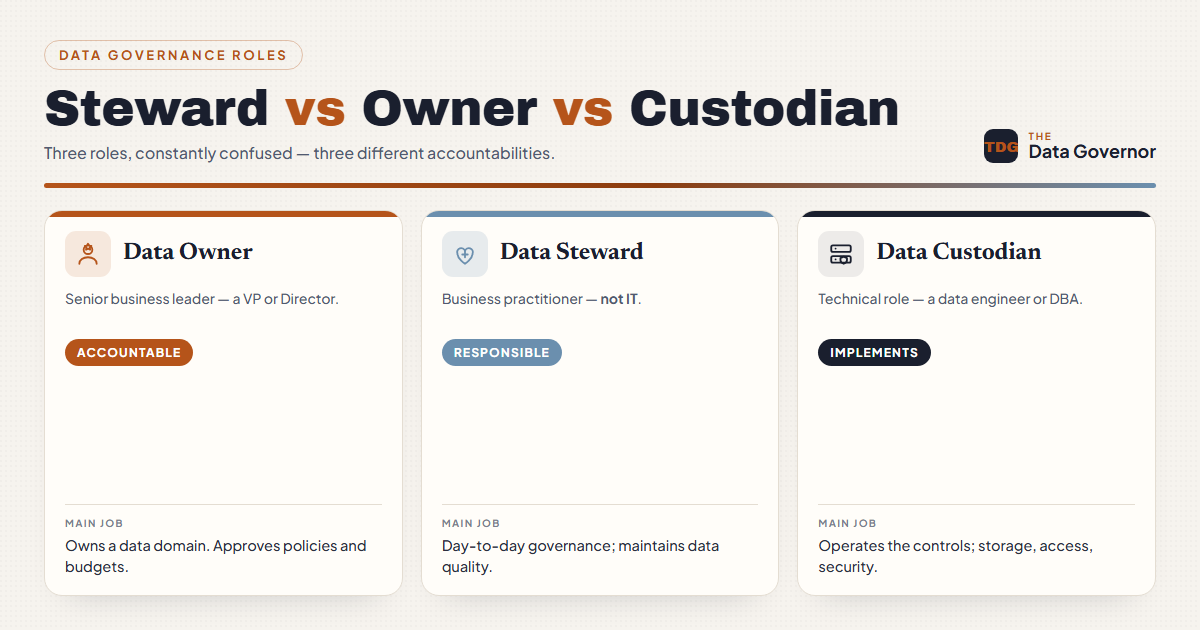
Walk into any data governance committee meeting and you’ll hear “data owner” and “data steward” used interchangeably within the same five minutes. They aren’t the same role. Confusing them is the single most common reason governance programs fail to assign clear accountability. This guide draws the lines, gives you a RACI you can actually use, and shows how the three roles are evolving in 2026.
In short: A data custodian is the technical role (data engineer, DBA, or platform engineer) that implements and operates the controls protecting data — storage, backups, encryption, access provisioning, and retention. A data steward is a business practitioner responsible for day-to-day data quality and definitions. A data owner is a senior business leader accountable for a data domain — they approve policy and own the budget. Custodians protect the data; stewards define it; owners answer for it.
- The 30-second definitions
- Data Owner: accountable for outcomes
- Data Steward: responsible for execution
- Data Custodian: implements the controls
- RACI in one table
- Common confusions and how to resolve them
- How these roles map to CISSP and information security
- How AI is changing each role in 2026
- Three rules for assigning these roles
- Frequently Asked Questions
The 30-second definitions
- Data Owner — A business leader accountable for the outcomes of a data domain. Approves policies, signs off on access, owns the budget. Accountable.
- Data Steward — A business practitioner responsible for the day-to-day quality, documentation, and policy adherence of a domain. Curates the glossary, triages quality issues, communicates with consumers. Responsible.
- Data Custodian — A technical role (usually IT or platform engineering) responsible for implementing the controls — encryption, backups, access provisioning, retention enforcement — that the owner approved and the steward maintains. Responsible (technical).
The owner sets the destination. The steward navigates the route. The custodian operates the vehicle.
Data Owner: accountable for outcomes
The data owner is a senior business stakeholder — typically a VP, director, or department head — who is accountable (in the RACI sense) for a defined data domain. Customer data, finance data, employee data, product telemetry: each domain needs an owner.
Concrete responsibilities:
- Approves the data governance policies that apply to the domain
- Signs off on access requests above a defined sensitivity threshold
- Approves data classification levels (public, internal, confidential, restricted)
- Owns the budget for governance work in their domain
- Resolves cross-functional disputes (e.g., “Marketing wants to use this data for X; Legal disagrees”)
- Represents the domain at the data governance council
Common job titles: VP Marketing (owns customer data), CFO (owns finance data), CHRO (owns employee data), Head of Product (owns product analytics).
Key signal you have a real owner: they have signed off on at least one access denial in the past six months. If owners only ever approve, they’re rubber-stamping, not owning.
Data Steward: responsible for execution
The data steward is a business practitioner — not IT — who handles the day-to-day work of governance for a domain. Stewards typically split their time 60/40 between stewardship and a primary business role.
Concrete responsibilities:
- Curates the business glossary entries for the domain
- Defines and maintains data quality rules
- Triages incoming data quality issues
- Reviews and approves new data product publications
- Communicates with downstream consumers (analytics teams, ML engineers)
- Escalates policy questions to the owner; escalates technical issues to the custodian
- Maintains the metadata in your data catalog
Common job titles: Senior Analyst, Domain Specialist, Data Steward (yes, the title exists — here’s a full job description with salary ranges if you’re hiring one), Customer Data Lead, Finance Data Manager.
Key signal you have a real steward: consumers of the domain know who to ask when they have a question. If “ask a data analyst” is the answer, you don’t have a steward — you have a help desk.
Data Custodian: implements the controls
The data custodian is the technical role — usually a data engineer, DBA, platform engineer, or security engineer — that operationally implements the controls owners approve and stewards maintain.
Concrete responsibilities:
- Provisions and de-provisions access per approved requests
- Implements encryption at rest and in transit
- Configures row/column-level security in the warehouse or lakehouse
- Maintains backups and disaster recovery
- Enforces retention policies (deletes data on schedule)
- Logs and monitors access for audit purposes
- Operates the catalog/governance platform (Collibra, Atlan, Purview)
Common job titles: Data Engineer, Database Administrator, Platform Engineer, Cloud Security Engineer, IAM Administrator.
Key signal you have a real custodian: they can produce an access log on demand. If “we don’t really log that” is the answer, you have a gap that compliance auditors will find.
Data custodian vs data steward: the one-line test
The fastest way to tell the two roles apart: the steward decides what “correct” means; the custodian makes sure the system enforces it. A steward writes the rule “customer email must be unique and valid.” A custodian implements the uniqueness constraint, the validation job, and the alert when it fails. Stewards live in the business glossary and the quality dashboard. Custodians live in IAM consoles, warehouse security settings, and backup schedules.
| Question | Data Steward | Data Custodian |
|---|---|---|
| Reports into | Business function (Finance, Marketing, Ops) | IT / Data Platform / Security |
| Primary artifact | Definitions, quality rules, classification decisions | Access controls, encryption, backups, retention jobs |
| Asks | ”Is this data right?" | "Is this data protected and available?” |
| Measured by | Quality scores, issue resolution time, glossary coverage | Uptime, access-review completion, audit findings, RPO/RTO |
| Typical titles | Data Steward, Domain Steward, Data Quality Analyst | DBA, Data Engineer, Platform Engineer, Cloud Security Engineer |
| Needs the other because | Rules without enforcement are suggestions | Controls without business definitions protect the wrong things |
One person can hold both hats in a small team — but the decisions should still be documented as two distinct roles, because the access-review evidence auditors want is a custodian artifact, and the definition-of-correct evidence is a steward artifact.
What a data custodian is responsible for, by layer
- Storage layer: database and lakehouse administration, capacity, backups, disaster recovery testing, encryption at rest.
- Access layer: provisioning and de-provisioning against approved requests, role-based and row/column-level security, periodic access recertification, privileged-access monitoring.
- Movement layer: encryption in transit, secure transfer of extracts, masking or tokenization in non-production environments.
- Lifecycle layer: executing retention schedules, legal-hold implementation, verified deletion (including backups and downstream copies).
- Evidence layer: access logs, change logs, and control-test results — the artifacts that turn “we have controls” into “we can prove it.”
Custodians do not decide who should have access, what the data means, or how long it should be retained. Those are owner and steward decisions. When custodians are making those calls by default, it usually means the business roles were never assigned — the most common failure pattern in programs that grew out of IT.
RACI in one table
Here’s how the three roles divide accountability for the most common governance activities:
| Activity | Owner | Steward | Custodian |
|---|---|---|---|
| Approve domain-level policy | A | C | I |
| Define data classification | A | R | I |
| Approve high-sensitivity access | A | C | R |
| Day-to-day access provisioning | I | C | R |
| Curate business glossary | A | R | I |
| Define data quality rules | A | R | C |
| Operate quality monitoring | I | A | R |
| Triage quality issue alerts | I | R | C |
| Encryption and backup | A | I | R |
| Retention enforcement | A | C | R |
| Audit log production | A | I | R |
| Approve new data product publication | A | R | C |
| Cross-domain dispute resolution | A/R | C | I |
(R = Responsible, A = Accountable, C = Consulted, I = Informed.)
Make this table yours: the interactive RACI builder starts from this framework with 16 pre-assigned activities, lets you rename roles and cycle assignments cell by cell, validates the one-Accountable rule live, and exports to CSV — free, no sign-up.
Common confusions and how to resolve them
”Our data steward is in IT.” Then they’re a custodian, not a steward. Stewardship is a business role; the moment it lives in IT, business consumers stop trusting that the data definitions reflect business reality. I watched this exact failure at the Department of Veterans Affairs before we restructured: IT-housed “stewards” kept technically pristine metadata that business staff quietly ignored, because the definitions described tables, not the mission. Fix: name a business steward, even if it’s a 30%-time appointment.
”Our data owner doesn’t know what they own.” Common when ownership is assigned by org chart rather than by domain. Fix: use a domain-led model. Map domains (customer, finance, product) first, then assign owners based on who has authority over that domain’s outcomes — not who manages the database.
”Our steward and custodian are the same person.” Workable in a small organization (under ~50 employees), problematic at scale. The conflict of interest — same person both maintains rules and operates controls — eventually causes audit findings. Fix: split before you scale past ~100 people.
”Our owner approves everything in 24 hours without reading.” Owner is rubber-stamping. Fix: introduce a quarterly access review where the steward presents a sample of approvals and the owner has to defend them. Pattern matches enterprise audit practice.
”We don’t have any of these roles, but we ‘do governance.‘” You don’t. You have ad-hoc data work. Defining these three roles — even badly — is step zero of an actual program.
How these roles map to CISSP and information security
If you’ve studied for the CISSP or come from a security background, you’ve met two of these roles already — under slightly different emphasis. In CISSP and information security, the data owner and data custodian are the two core roles; the data steward is a data-governance addition that security frameworks mention less often.
- Data owner (CISSP) — usually senior management. Holds ultimate responsibility for the data, classifies it (e.g., public/internal/confidential/restricted), and defines the protection and handling requirements. This is the same accountable role described above, framed around classification and risk.
- Data custodian (CISSP) — the IT/technical role that implements and maintains the controls the owner specifies: backups, encryption, access provisioning, and retention enforcement. Identical to the implements role above.
- Data steward — a governance/DAMA-DMBOK concept for the business practitioner who curates definitions and data quality. CISSP touches it lightly, which is exactly why security and governance teams talk past each other.
Two more roles cause confusion because they come from privacy law, not security operations: the data controller and data processor are GDPR/CCPA terms describing who decides the purpose of processing vs who processes on their behalf — organizational roles, not the internal accountability roles covered here. A single company is usually the controller; its data owners, stewards, and custodians sit inside it.
How AI is changing each role in 2026
The EU AI Act and the rise of agentic AI are reshaping all three roles:
Data Owner gains “AI use approval” responsibility. Owners are increasingly asked to approve or deny use of their domain’s data for ML training. This requires owners to develop fluency in concepts like training-data lineage, bias risk, and model output consequences. Many owners are getting data literacy training for the first time.
Data Steward bifurcates into business steward + AI steward. As covered in our 2026 trends piece, the steward role is splitting. Business stewards keep traditional duties; AI stewards (or “model stewards”) own model card maintenance, training data documentation, bias monitoring, and AI Act conformity artifacts. Expect two job descriptions where you used to have one.
Data Custodian gains AI-specific control responsibilities. Custodians now also implement model registry controls, feature store access policies, and inference-time logging. The AI Act treats inference logs as audit material, which means custodians need to operationalize log retention for ML systems the way they already do for databases.
Three rules for assigning these roles
-
Assign owners by domain, not by department. “Customer data” is a domain. “Marketing” is a department. The customer data owner is whoever has the most authority over customer-data outcomes — often Marketing’s VP, sometimes the Chief Customer Officer, occasionally Product. Choose by authority, not by who happens to manage the database.
-
Make stewards visible to data consumers. A steward whose name doesn’t appear in the catalog, in Slack channels, or on data product pages isn’t really stewarding. Make their name and contact route the first thing consumers see when they look up a dataset.
-
Give custodians veto power on technical implementability. If the owner approves a policy the custodian can’t enforce technically, the policy is fiction. Build a 24-hour review window where custodians can flag “approved policy A is not enforceable in our current platform” before it becomes official. Avoids policy debt.
Get these three roles named, distinguished, and accountable, and 70% of the operational work of a data governance framework becomes execution rather than negotiation. Conflate them, and every quality issue, access request, and compliance question turns into a meeting.
Frequently Asked Questions
What is a data custodian?
A data custodian is the technical role responsible for the safe storage, transport, and operational protection of data — implementing the access controls, encryption, backups, and retention rules that data owners approve and data stewards define. Custodians are usually database administrators, data engineers, platform engineers, or security engineers.
What is the difference between a data steward and a data custodian?
A data steward is a business-side role responsible for what the data means and whether it is correct — definitions, quality rules, and classification. A data custodian is a technical role responsible for how the data is protected and delivered — storage, access provisioning, encryption, and retention enforcement. The steward defines “correct”; the custodian enforces it in systems.
Is a DBA a data custodian?
Usually, yes. A database administrator who manages storage, backups, permissions, and encryption for a dataset is performing the data custodian role for that dataset, whether or not the title is used. Cloud platform engineers and IAM administrators fill the same role for lakehouse and SaaS data.
What is the difference between a data owner and a data custodian?
The data owner is the business executive accountable for a data domain’s outcomes — they approve policy, sign off on access, and own the budget. The data custodian implements the technical controls the owner approves. Owners decide; custodians execute. In RACI terms the owner is Accountable and the custodian is Responsible for technical controls.
How does CISSP define data owner, data custodian, and data steward?
In CISSP and most information security frameworks, the data owner (sometimes “information owner”) is accountable for classification and access decisions; the data custodian is the technical role that implements protection according to the owner’s classification; and the data steward manages data content and quality on the owner’s behalf. The security definitions align closely with the governance definitions used in this guide.
Can one person be both data steward and data custodian?
Yes, especially in smaller organizations, but the two sets of responsibilities should still be documented separately. Auditors look for access-review and control evidence (custodian work) and for definition and quality evidence (steward work). Combining the roles in one person is fine; combining them into one undefined responsibility is not.
Who does the data custodian report to?
Data custodians almost always sit in IT, the data platform team, or information security, reporting through technology leadership. Data stewards sit in the business function that produces or most depends on the data. This reporting split is deliberate: it keeps control implementation independent from the people asking for access.
Further Reading
- What Is a Data Steward? The Complete Guide for 2026
- Data Steward Job Description: Duties, Skills, Salary
- Free Data Steward JD Template Pack
- Data Governance Framework: A Practitioner’s Guide
- Data Governance Policy: The Complete Implementation Guide for 2026
- The Chief Data Officer’s Guide to Data Governance in 2026