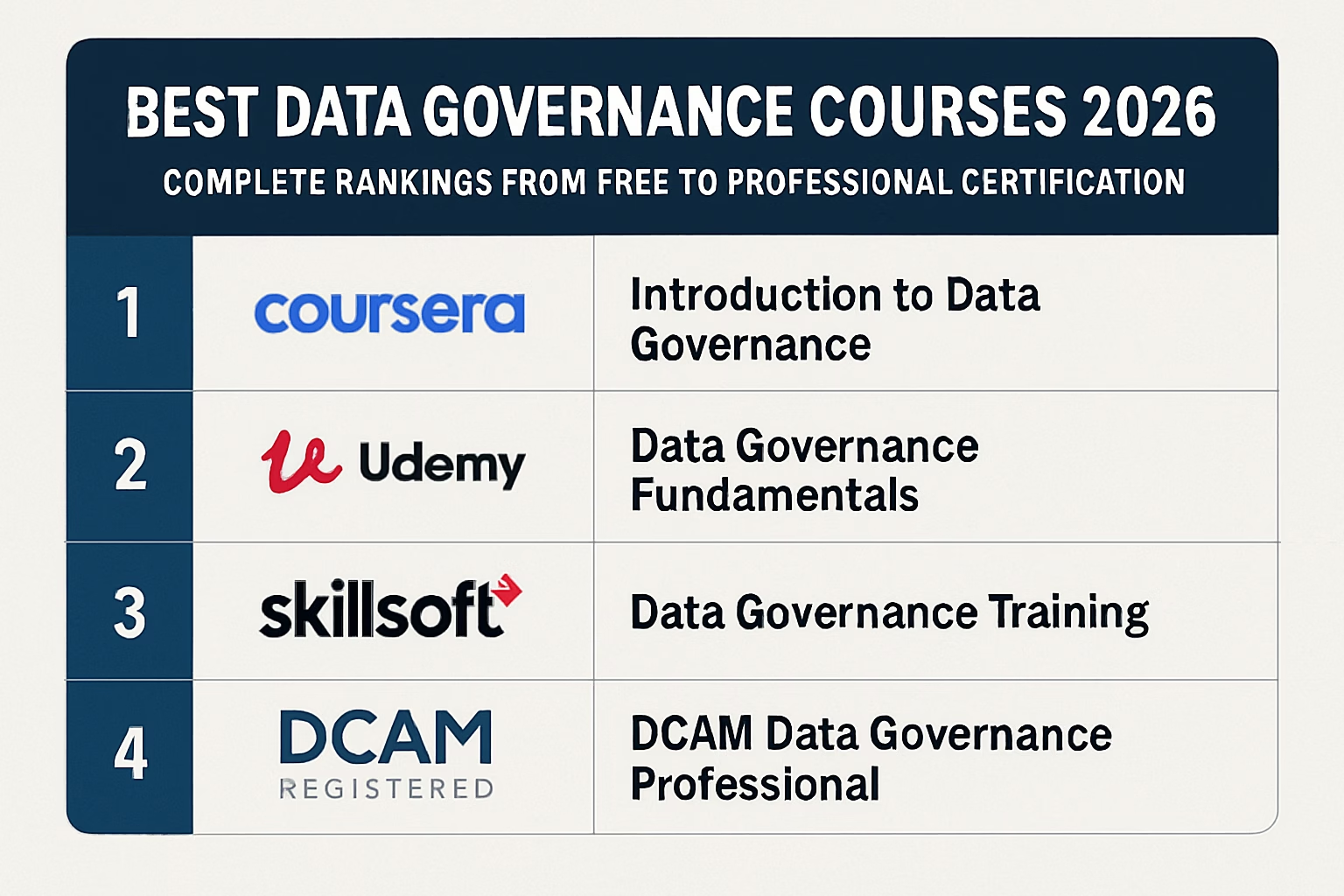
Data governance courses have evolved from niche professional development into essential career credentials as organizations face mounting regulatory pressure, AI governance requirements, and data-driven transformation initiatives. The right training can accelerate your governance career, validate expertise to employers, and provide practical frameworks for implementing governance programs.
In 2026, the data governance training landscape spans from free introductory courses to premium professional certifications costing thousands of dollars. This comprehensive guide ranks the best data governance courses across all price points, evaluating course quality, practical applicability, instructor expertise, certification value, and return on investment. The challenge facing aspiring governance professionals isn’t finding training—it’s choosing the right investment for your career stage, learning style, and professional goals. A $5,000 certification program makes sense for mid-career professionals pursuing governance leadership roles. That same investment wastes resources for early-career analysts exploring whether governance interests them.
This guide is written for career changers evaluating governance as a profession, early-career data professionals building foundational knowledge, mid-career practitioners pursuing recognized certifications, governance managers training teams, and executives understanding available training for their organizations.
You’ll learn which free courses provide genuine value versus marketing disguised as education, which paid courses justify their cost through career advancement, which certifications employers actually recognize, and how to build a governance learning path matching your career trajectory.
This isn’t a compilation of course listings copied from training provider websites. This is a practitioner evaluation of governance training based on real-world applicability, career impact, and honest assessment of what these courses actually deliver.
Short answer: if you want one data governance certification that travels across industries, get the DAMA CDMP. If you work in banking or insurance, add DCAM from the EDM Council. If your job is tied to a platform, the vendor credential (Collibra, Informatica, Microsoft Purview) matters more to hiring managers than any general certificate. Everything below explains why, and what each path costs.
Data Governance Certification: Quick Comparison
Direct answer: the best data governance certification for most professionals is the CDMP (Certified Data Management Professional) from DAMA International. It’s the closest thing the field has to a global standard — vendor-neutral, built on the DAMA-DMBOK body of knowledge, recognized across industries from retail to healthcare to financial services, and held by governance leaders at companies with no shared platform or regulatory profile in common. That portability is what separates it from every alternative on this page.
That said, “best” depends on your lane. If your governance work is really privacy work — you’re managing GDPR or CCPA compliance more than data quality or stewardship — the IAPP’s CIPP credentials carry more weight with hiring managers than CDMP does. If you work inside a regulated bank or insurer, DCAM from the EDM Council is closer to table stakes than CDMP is. If your job is tied to a specific tool, a Collibra, Informatica, or Microsoft Purview credential will matter more in your next performance review than a general certificate. CDMP is the right default when you’re not sure which of those describes you.
Certification is the question most readers arrive with, so here is the comparison up front. Costs are typical US figures at time of writing; verify with the provider before budgeting.
| Certification | Issuer | Best for | Typical all-in cost | Recognition | Renewal |
|---|---|---|---|---|---|
| CDMP (Certified Data Management Professional) | DAMA International | Governance generalists, managers, consultants | $311 exam + $0–$2,400 prep | Highest cross-industry recognition | Every 3 years ($100 + CPE) |
| CDMP Specialist exams (Data Governance, Data Quality, MDM, Metadata) | DAMA International | Deepening one DMBOK area after CDMP | $311 per specialist exam | Strong in mature data organizations | With CDMP |
| DCAM training and certification | EDM Council | Financial services governance and regulatory reporting (BCBS 239) | $2,000–$5,000 via authorized partners | Standard in banking and insurance; limited elsewhere | Ongoing participation |
| Collibra University certifications (e.g., Collibra Ranger) | Collibra | Collibra administrators and stewards | Included with customer access; paid tracks for partners | High for Collibra shops; low outside | Version-based |
| Informatica certifications (Data Governance & Catalog, MDM) | Informatica | Informatica administrators and architects | Exam fees vary by track | High for Informatica shops | Version-based |
| Microsoft SC-401 (Information Security Administrator, covers Purview) | Microsoft | Azure and M365 shops running Purview | ~$165 exam | Growing with Purview adoption | Annual free renewal |
| IAPP CIPP/US or CIPP/E | IAPP | Privacy-heavy governance roles (CCPA, GDPR) | ~$550 exam + membership | Very high in privacy; adjacent to governance | Every 2 years (CPE) |
| Free course certificates (Coursera, DataCamp, LinkedIn Learning) | Various | Career exploration, résumé signal for entry roles | $0–$50/month | Low; shows initiative only | None |
Three patterns worth noting. First, CDMP is the only credential that is portable across industries and vendors, which is why it anchors the recommendations below. Second, DCAM’s value is concentrated — it is close to expected in bank data offices and nearly unknown outside regulated finance. Third, vendor certifications have the fastest payback when you already work on that platform: a Collibra-certified steward or Purview-certified administrator is immediately more useful to their employer, whereas a general certificate pays back over a longer horizon through role changes and salary negotiations.
CDMP Certification Levels & Prerequisites
CDMP isn’t a single pass/fail credential — DAMA structures it in levels, and the level you hold depends on which exams you’ve passed.
- Associate: earned by passing the Data Management Fundamentals exam ($311). It requires only that one exam, which is why it’s the common entry point for early-career professionals and career changers.
- Practitioner: requires the Fundamentals exam plus two specialist exams ($311 each) in areas like Data Governance, Data Quality, Master Data Management, or Metadata.
- Master: DAMA’s senior level, above Practitioner.
If you’re early in your career, don’t be discouraged by starting at Associate — most practitioners add specialist exams over time rather than attempting everything at once. DAMA sets the exact criteria for each level, so confirm the current requirements with DAMA before you book.
How We Ranked Data Governance Courses
This ranking evaluates courses across multiple dimensions creating a comprehensive quality assessment.
Course Quality and Content Depth
Governance training varies dramatically in rigor and depth. Introductory courses might provide basic definitions and frameworks in 2-3 hours. Comprehensive programs cover governance implementation, tool selection, change management, and advanced topics over 40+ hours. Quality assessment examines whether content is current (updated for 2026 AI governance and privacy regulations), whether frameworks are practical (can you actually implement what’s taught?), whether examples are real-world rather than generic, and whether topics cover breadth across governance dimensions. Courses scoring high on quality provide actionable guidance you can apply immediately. Courses scoring low offer generic theory disconnected from practice.
Instructor Expertise and Credibility
Governance education quality depends heavily on instructor experience. Practitioners who have implemented governance programs teach differently than academics who study governance theoretically. Instructor evaluation considers hands-on implementation experience, recognized industry expertise, current practitioner status versus retired consultants teaching outdated practices, and ability to provide real-world examples beyond textbook scenarios. The best governance instructors have battle scars from failed initiatives, challenging stakeholders, and governance complexity. They teach what works and what fails, not just what should work theoretically.
Practical Applicability
Many governance courses teach impressive-sounding frameworks that prove useless in real organizations. Practical applicability measures whether course content translates to actual governance work. Evaluation criteria include actionable templates and tools you can use immediately, change management guidance for driving governance adoption, realistic implementation timelines acknowledging organizational resistance, and problem-solving approaches for common governance challenges. Courses strong in practical applicability prepare you for governance reality. Courses weak in applicability leave you unprepared for implementation challenges.
Certification Value and Industry Recognition
Professional certification value varies dramatically. Some certifications are globally recognized by employers and enhance career prospects. Others are vanity credentials carrying no weight in hiring decisions. Certification evaluation examines employer recognition in governance job postings, salary impact for certified versus non-certified professionals, certification maintenance requirements and costs, and credibility of certifying organization. The most broadly recognized certification is CDMP from DAMA International; DCAM carries significant weight in financial services. DATAVERSITY’s applied governance training is worthwhile professional development, but it’s a learning program, not an employer-screened credential. Platform-specific training (Collibra, Informatica) provides tool expertise but doesn’t replace general governance certification.
Return on Investment
Course cost matters, but ROI matters more. A $300 course that doesn’t advance your career wastes money. A $5,000 certification that increases salary by $20,000 annually delivers exceptional ROI. ROI evaluation considers direct costs (tuition, exam fees, study materials), indirect costs (time investment, opportunity cost), career impact (promotions, salary increases, job opportunities), and time to ROI (how quickly does certification pay for itself?). Free courses provide excellent ROI for career exploration and foundational knowledge. Premium certifications provide strong ROI for mid-career professionals pursuing governance specialization. Expensive courses without recognized certification often provide poor ROI.
Free Data Governance Courses
Free courses provide valuable foundational knowledge without financial risk. Quality varies from excellent introductions to marketing disguised as education.
Coursera: Fundamentals of Data Governance (FREE Audit)
Provider: Coursera Platform
Cost: Free to audit (certificate $49)
Duration: 8-10 hours
Level: Beginner
Course Content: This course provides solid foundational coverage of governance principles, frameworks, and implementation basics. Topics include governance definition and importance, policy and standards development, data quality fundamentals, metadata management basics, stewardship roles and responsibilities, and compliance requirements overview. The course uses case studies from various industries showing governance application in different contexts. Content is current with 2026 updates covering AI governance and modern privacy regulations.
Strengths: Excellent introduction for governance newcomers. Content is well-structured progressing logically from concepts to implementation. Video quality is professional with clear explanations. Free audit access allows full content review without payment. The course provides downloadable templates and frameworks you can adapt to your organization.
Limitations: Depth is limited—this is introduction, not comprehensive training. Implementation guidance is high-level rather than detailed. No hands-on exercises or practical application. Certificate requires payment and carries limited industry recognition compared to CDMP.
Best For: Career changers exploring whether governance interests them, early-career professionals building foundational knowledge, business users wanting to understand governance programs.
Our Rating: 4.5/5 for free content quality; 3/5 for certificate value
DataCamp: Data Governance Concepts (FREE Trial)
Provider: DataCamp
Cost: Free 14-day trial (subscription $25/month)
Duration: 2 hours
Level: Beginner
Course Content: DataCamp’s governance course covers core concepts: what data governance is and why it matters, governance framework components and principles, roles and responsibilities in governance programs, data quality dimensions and management, and governance implementation basics. Content is interactive with coding exercises, though governance doesn’t require heavy coding. The platform’s strength is interactive learning format.
Strengths: Quick introduction covering essentials in 2 hours. Interactive exercises reinforce learning. Platform is user-friendly with progress tracking. Free trial allows full access to this and other data management courses.
Limitations: Very introductory—not sufficient for professional practice. Limited implementation depth. Subscription required beyond free trial for ongoing access. Certificate isn’t recognized industry credential.
Best For: Data professionals adding governance knowledge to existing technical skills, students exploring data management topics, teams wanting quick governance overview.
Our Rating: 4/5 for introduction; 2/5 for professional credential value
LinkedIn Learning: Data Governance Fundamentals (FREE with LinkedIn Premium)
Provider: LinkedIn Learning
Cost: Free with LinkedIn Premium ($40/month with free trial)
Duration: 3-4 hours
Level: Beginner to Intermediate
Course Content: LinkedIn Learning offers multiple governance courses. The fundamentals course covers governance program structure, policy development and enforcement, data quality management approaches, metadata and master data management, access governance and security, and compliance and risk management. Instructors are practicing professionals rather than pure academics, providing practical perspectives.
Strengths: Accessible with LinkedIn Premium many professionals already have. Instructors provide real-world examples from their implementation experience. Content is regularly updated. Multiple related courses allow exploration of specific governance topics in depth.
Limitations: Course depth varies by instructor. Some content feels like consultant marketing for their services. Certificate of completion holds minimal value with employers. Subscription required for access.
Best For: Professionals with existing LinkedIn Premium, managers wanting governance overview for team oversight, consultants needing refresher on governance topics.
Our Rating: 3.5/5 for content quality; 2/5 for certification value
YouTube: Free Governance Content from The Data Governor
Provider: Independent content creators
Cost: FREE
Duration: Varies by content
Level: All levels
Course Content: YouTube hosts extensive free governance content from practitioners and consultants. Quality varies dramatically from excellent to worthless. Recommended channels include The Data Governor for practitioner-focused guidance, DATAVERSITY for conference presentations and webinars, DAMA chapters posting local event recordings, and tool vendors (Collibra, Informatica) providing platform training.
Strengths: Completely free with no subscription. Wide variety covering specific governance topics in depth. Practitioner perspectives from those doing actual governance work. Ability to sample many sources and find teaching styles matching your learning preference.
Limitations: No structured curriculum or learning path. Quality highly variable requiring evaluation of each source. No certification or formal recognition. Content may be outdated—check publication dates.
Best For: Self-directed learners comfortable creating their own curriculum, professionals researching specific governance topics, supplementing formal training with additional perspectives.
Our Rating: 3.5/5 for content availability; 1/5 for structured learning
Affordable Paid Courses ($50-$500)
Affordable courses provide structured learning with modest investment. These courses work well for building foundational knowledge before committing to expensive certification programs.
Udemy: Data Governance – The Complete Course for Beginners
Provider: Udemy
Instructor: George Smarts
Cost: $50-$80 (varies with sales)
Duration: 9 hours (160 lectures)
Level: Beginner to Intermediate
Course Content: This comprehensive Udemy course covers what data governance actually is and why it matters, roles and responsibilities in governance programs, governance frameworks and implementation approaches, policy development (compliance, access, security, quality), data stewardship and RACI charts, governance metrics and scorecards, tools and techniques for governance implementation, certification guidance and preparation, and AI governance trends and future directions. The course updated in March 2026 includes current AI governance and privacy regulation content.
Strengths: Comprehensive coverage for beginner price point. Lifetime access allowing return to materials as needed. 160 lectures provide extensive detail on governance topics. Regularly updated with current content. Practical templates and examples included. Affordable price frequently discounted during Udemy sales.
Limitations: Instructor lacks name recognition in governance field. Certificate of completion not recognized credential. No live interaction or instructor Q&A. Some content feels padded to reach 9-hour duration. Implementation guidance is generic rather than industry-specific.
Best For: Budget-conscious learners building governance foundation, career changers wanting comprehensive overview before certification investment, teams wanting affordable baseline training.
Our Rating: 4/5 for value at price point; 3/5 for professional applicability
Data Governance – The Complete Course for Beginners
The best-value structured foundation in this guide: comprehensive governance curriculum, lifetime access, and frequently discounted. Our pick for budget-conscious beginners building a base before any certification spend.
View the course on Udemy → Affiliate link — we may earn a commission at no extra cost to you.Pluralsight: Data Governance Fundamentals
Provider: Pluralsight
Cost: $299/year subscription
Duration: 3 hours core course plus related content
Level: Intermediate
Course Content: Pluralsight’s governance course focuses on technical implementation: governance program planning and design, data modeling and architecture for governance, master data management and data hubs, database administration in governed environments, data quality management and monitoring, and blockchain for data integrity (emerging topic). Course targets IT professionals implementing governance infrastructure rather than governance program leaders.
Strengths: Technical depth appropriate for data engineers and architects. Subscription provides access to extensive related data management content. Learning paths guide progression through related topics. Skill assessments measure knowledge before and after training.
Limitations: Subscription cost high for single course access. Technical focus may not suit non-IT governance roles. Limited coverage of governance soft skills like stakeholder management. Certificate not industry-recognized credential.
Best For: Data engineers and architects implementing governance infrastructure, IT professionals supporting governance programs, technical leads wanting governance context for their work.
Our Rating: 4/5 for technical professionals; 2.5/5 for business-side governance roles
Mid-Range Professional Training ($500-$2,500)
Mid-range courses provide structured professional development preparing for recognized certifications or providing vendor-specific expertise. If you’re weighing platform-specific training, it’s worth knowing which platform your organization is likely to land on first — the governance platform selector walks through that decision in a few minutes.
DATAVERSITY: Applied Data Governance Learning Plan
Provider: DATAVERSITY
Cost: $599-$1,599 (depends on specialization)
Duration: 20-40 hours on-demand
Level: Intermediate to Advanced
Course Content: DATAVERSITY’s learning plans provide comprehensive governance coverage: governance frameworks and operating models, policy development and enforcement, data quality management programs, metadata and business glossary management, stewardship programs and change management, governance metrics and ROI demonstration, compliance with GDPR, CCPA, HIPAA, and tool selection and implementation guidance. Content prepares specifically for the CDMP certification exam. Courses taught by recognized industry practitioners with implementation experience.
Strengths: Courses directly prepare for industry-recognized CDMP certification. Instructors are practicing governance professionals, not just trainers. Content is comprehensive and current. On-demand format allows flexible pacing. DATAVERSITY has periodically offered CDMP exam discounts to training participants — verify current terms before enrolling. Templates and tools provided for immediate application.
Limitations: Higher cost than introductory courses though still significantly cheaper than certification boot camps. On-demand format lacks live interaction and Q&A. Requires self-discipline for completion without deadlines. Some content is CDMP exam-focused rather than purely practical.
Best For: Professionals preparing for CDMP certification, mid-career practitioners formalizing governance knowledge, governance program leads building comprehensive expertise.
Our Rating: 4.5/5 for certification preparation; 4/5 for practical application
Collibra University: Data Governance Fundamentals (Platform Training)
Provider: Collibra
Cost: FREE to $500 (varies by course)
Duration: 4-12 hours per course
Level: Beginner to Advanced
Course Content: Collibra University provides platform-specific training covering Collibra platform navigation and configuration, business glossary creation and maintenance, data catalog implementation, stewardship workflows and automation, data quality rule configuration, and integration with data sources and BI tools. Training focuses on Collibra platform skills rather than general governance principles.
Strengths: Essential training if your organization uses Collibra. Platform-specific skills are immediately applicable. Some courses are free for Collibra users. Certification demonstrates platform expertise valuable to employers using Collibra. Hands-on labs provide practical experience.
Limitations: Platform-specific—doesn’t transfer to other governance tools. Doesn’t replace comprehensive governance education. Value limited if your organization doesn’t use Collibra. Certification is vendor credential, not general governance certification.
Best For: Collibra platform administrators and stewards, governance professionals working in Collibra environments, consultants specializing in Collibra implementations.
Our Rating: 5/5 for Collibra users; 2/5 for general governance education
Informatica Data Governance Training
Provider: Informatica
Cost: $1,000-$2,000 per course
Duration: 3-5 days per course
Level: Intermediate to Advanced
Course Content: Informatica offers comprehensive training on their governance platform: Axon Data Governance platform administration, metadata management and enterprise data catalog, data quality and profiling with Informatica tools, master data management with MDM Multidomain, and integration with Informatica data integration tools. Training combines concepts with hands-on platform exercises.
Strengths: Comprehensive platform training for enterprise deployments. Instructor-led format provides live Q&A and interaction. Hands-on labs with Informatica environments. Platform certification demonstrates expertise valuable to employers. Training includes real-world implementation scenarios.
Limitations: Expensive—among the highest-cost governance training. Platform-specific rather than general governance education. Value limited without access to Informatica platforms. Training schedule may not align with your availability.
Best For: Informatica administrators and developers, governance professionals in Informatica environments, consultants implementing Informatica solutions.
Our Rating: 4.5/5 for Informatica practitioners; 2/5 for general governance education
Premium Certification Programs ($2,500-$5,000+)
Premium programs provide comprehensive education preparing for industry-recognized professional certifications carrying significant career value.
DATAVERSITY: CDMP Certification Boot Camp
Provider: DATAVERSITY
Cost: $1,000-$2,400 (live instructor-led)
Duration: 2-4 days intensive or 6 weeks extended
Level: Intermediate to Advanced
Course Content: DATAVERSITY’s CDMP boot camp covers the complete DAMA-DMBOK framework preparing for Certified Data Management Professional certification: data governance fundamentals and frameworks, data architecture and modeling, data quality management, metadata management, master and reference data management, data security and privacy, data warehousing and business intelligence, document and content management, big data and data science, and data ethics and management. Boot camps are taught by DAMA-certified instructors with deep governance implementation experience.
Strengths: Direct preparation for globally-recognized CDMP certification. Intensive format accelerates learning. Instructors provide real-world implementation guidance beyond textbook theory. Includes CDMP exam voucher (20% discount). Live format allows Q&A and networking with other governance professionals. DATAVERSITY has trained thousands of CDMP candidates with high pass rates.
Limitations: Significant cost investment though provides strong ROI through certification. Intensive schedule requires dedicated time commitment. Exam is separate additional cost ($311). Content is comprehensive but dense—challenging for complete beginners. Certification maintenance requires renewal every 3 years ($100).
Best For: Mid-career professionals pursuing governance specialization, governance program managers seeking formal credentials, consultants needing recognized certification, career changers making significant governance commitment.
Our Rating: 5/5 for career advancement; 4.5/5 for practical application
ROI Analysis: CDMP certification correlates with $15,000-$25,000 salary increase for governance roles. At $2,400 training cost plus $311 exam, certification pays for itself within 2-3 months.
MIT Professional Education: Data Leadership – AI, Cloud & Governance
Provider: MIT Professional Education
Cost: $3,200
Duration: 8 weeks (6.4 CEUs)
Level: Advanced/Executive
Course Content: MIT’s executive program focuses on data leadership combining governance with emerging technologies: cloud data architecture and governance, AI and machine learning governance, DevOps and DataOps methodologies, data strategy and business alignment, data quality and real-time analytics, governance in data-in-motion pipelines, and decision-making frameworks using governed data. Program targets senior leaders rather than governance practitioners.
Strengths: MIT brand carries significant professional cachet. Executive-level perspective suitable for leadership roles. Current content addressing 2026 AI governance challenges. Networking with senior professionals from diverse industries. CEU credits for professional development. Curriculum designed by MIT faculty.
Limitations: Expensive—highest-cost option in this guide. Targets executives, not hands-on practitioners. Doesn’t prepare for CDMP or other recognized certifications. Certificate is course completion, not professional credential. Technical content may be too high-level for technical implementers.
Best For: Senior executives leading data-driven transformation, CDOs building governance programs, VPs needing governance context for strategic decisions, consultants working with C-suite clients.
Our Rating: 4/5 for executives; 3/5 for practitioners
CDMP Certification Boot Camp (European Providers)
Provider: IMF Academy and similar European training firms
Cost: €4,380 ($4,750 USD) excluding VAT
Duration: 4 days intensive
Level: Intermediate to Advanced
Course Content: European CDMP boot camps cover identical DAMA-DMBOK content as US providers but offer international perspective and GDPR focus: complete DAMA-DMBOK coverage across 14 knowledge areas, CDMP exam preparation with practice tests, official DAMA-DMBOK2 guide included, CDMP exam voucher (€400 value), and European regulatory focus including GDPR, EU Data Act, AI Act. Training conducted in Amsterdam and other European cities or live online.
Strengths: Comprehensive CDMP preparation with European regulatory focus. Includes exam voucher and official study guide. Intensive 4-day format concentrates learning. High pass rates reported by training provider. European time zones convenient for international participants.
Limitations: Expensive—among highest-cost CDMP training options. European VAT may apply increasing total cost. Limited training dates require schedule flexibility. Travel costs if attending in-person. Same certification as US training at higher cost.
Best For: European professionals pursuing CDMP, international consultants wanting European regulatory perspective, governance professionals working across multiple jurisdictions.
Our Rating: 4.5/5 for European market; 3.5/5 for US market (due to cost)
Industry-Specific and Specialized Training
Certain governance training targets specific industries or specialized topics providing depth beyond general programs.
DCAM Certification (Financial Services Focus)
Provider: EDM Council
Cost: Variable (typically $2,000-$5,000 through training partners)
Duration: Varies by provider
Level: Advanced
Course Content: DCAM (Data Management Capability Assessment Model) training prepares professionals for financial services governance: banking regulatory requirements and expectations, DCAM framework and assessment methodology, data governance in regulatory reporting, model risk management and model governance, risk data aggregation and reporting (BCBS 239), and financial data quality and lineage. DCAM is the recognized governance framework in banking and insurance.
Strengths: Industry-standard framework in financial services. Regulatory bodies reference DCAM in examinations. Strong salary premium for DCAM certification in banking. Training providers include financial services case studies. Recognized globally in banking industry.
Limitations: Industry-specific—limited value outside financial services. Expensive training and assessment costs. Complex framework requiring significant study. Assessment often requires external consultants. Maintenance requires ongoing participation.
Best For: Governance professionals in financial services, bank regulatory compliance teams, consultants serving banking clients, risk management professionals.
DCAM certification cost, broken down: the figure that surprises people is that DCAM is priced as a training-plus-certification package sold by the EDM Council and its authorized training partners, not as a standalone exam. Expect the certified-practitioner track to land in the $2,000–$5,000 range per person depending on partner, format (virtual vs. in-person), and whether your organization is an EDM Council member, which discounts the price. The DCAM assessor track — required if you will formally score an organization against the framework — sits at the upper end. Budget additionally for the assessment itself if your organization plans a formal DCAM score, which is typically consultant-led and priced separately. For an individual practitioner in banking, the training track alone is usually sufficient; only certify as an assessor if your role includes running the assessment.
Our Rating: 5/5 for financial services; 2/5 for other industries
AI Governance Specialized Training
Provider: Multiple providers (DATAVERSITY, ITU Academy, emerging specialists)
Cost: $500-$2,000
Duration: 4-16 hours
Level: Intermediate to Advanced
Course Content: AI governance training addresses emerging requirements: AI Act compliance (Europe), AI ethics and responsible AI frameworks, bias detection and fairness testing, AI model governance and lineage, training data governance and quality, generative AI governance challenges, and AI explainability and transparency requirements. Training updated frequently as AI regulations evolve.
Strengths: Addresses critical emerging governance area. Content current with 2026 regulatory landscape. Practical guidance for AI governance implementation. Combines technical and policy perspectives. Growing demand for AI governance expertise.
Limitations: Rapidly evolving field—training may become outdated quickly. Limited recognized certifications yet available. Best practices still emerging. Training quality varies significantly across providers. May overlap with existing data governance knowledge.
Best For: Governance professionals supporting AI initiatives, AI ethics officers, compliance professionals addressing AI regulations, consultants advising on AI governance.
Our Rating: 4/5 for timely topic; 3/5 for standardization
Healthcare Data Governance Training
Provider: AHIMA, HIMSS, specialized consultants
Cost: $500-$2,000
Duration: 8-24 hours
Level: Intermediate
Course Content: Healthcare-specific governance addresses unique industry requirements: HIPAA compliance and PHI protection, clinical data governance for patient safety, healthcare interoperability and FHIR standards, master patient index quality management, healthcare privacy and consent management, and clinical quality measure reporting governance. Training reflects healthcare regulatory complexity.
Strengths: Industry-specific addressing healthcare governance challenges. Taught by healthcare data professionals. Compliance focus aligned with regulatory priorities. Practical case studies from healthcare organizations. Certification available through AHIMA for health information professionals.
Limitations: Healthcare-specific with limited transferability. Training often focuses heavily on compliance versus business value. Certification requires healthcare IT background. May overlap significantly with general governance training.
Best For: Health information management professionals, healthcare data stewards, clinical informaticists, healthcare compliance officers.
Our Rating: 4.5/5 for healthcare; 2/5 for general governance
How to Choose the Right Data Governance Course
Selecting appropriate governance training requires matching course characteristics to your career stage, goals, and constraints.
Assess Your Career Stage and Goals
Career Exploration (Entry-Level): If you’re exploring whether governance interests you, start with free courses. Coursera’s fundamentals course or YouTube content from The Data Governor provide excellent introduction without financial commitment. Invest 10-20 hours exploring governance concepts before committing to paid training. If you want to understand what a data governance analyst does day-to-day before committing to a career path, that’s a good place to start.
Foundation Building (Early Career): Early-career professionals building foundational knowledge benefit from affordable structured courses. Udemy’s comprehensive beginner course ($50-$80) or DATAVERSITY’s entry-level learning plans ($599) provide structured learning at reasonable cost. Avoid expensive certifications until you confirm governance career direction.
Specialization (Mid-Career): Mid-career professionals pursuing governance specialization should invest in recognized certification. CDMP certification through DATAVERSITY boot camp ($1,000-$2,400) provides strongest ROI through salary increase and job opportunities. Platform-specific training (Collibra, Informatica) supplements general certification if your organization uses those tools.
Leadership (Senior/Executive): Senior leaders benefit from executive programs providing strategic perspective. MIT’s Data Leadership program ($3,200) or executive-focused DATAVERSITY courses address governance from business strategy lens. Avoid practitioner-level training focusing on implementation details.
Consider Your Learning Style
Self-Paced Learners: If you learn best independently at your own pace, choose on-demand courses with flexible deadlines. DATAVERSITY’s learning plans, Udemy courses, and LinkedIn Learning provide quality self-paced options. Ensure you have discipline for completion without external deadlines.
Structured Learners: If you need structure and deadlines, choose instructor-led boot camps with fixed schedules. DATAVERSITY’s live boot camps or certification programs with cohort-based learning provide external accountability.
Hands-On Learners: If you learn through practice, prioritize courses with exercises, labs, and templates. Platform training (Collibra, Informatica) provides extensive hands-on practice. DATAVERSITY courses include templates and tools for immediate application.
Evaluate Certification Requirements
Determine whether your career goals require professional certification. Governance leadership roles increasingly require CDMP or equivalent certification. Tool-specific roles may prioritize platform certification. Consulting roles benefit from multiple recognized credentials. If certification is required, choose training explicitly preparing for certification exams rather than general governance courses. CDMP preparation requires specific DAMA-DMBOK knowledge that general courses may not cover adequately.
Calculate Total Investment
Consider all costs when evaluating courses:
Direct Costs: Course tuition, exam fees ($311 for CDMP), study materials, certification maintenance ($100 every 3 years for CDMP)
Indirect Costs: Time investment (20-100 hours), opportunity cost of not working during intensive boot camps, potential travel for in-person training
Expected Returns: Salary increase from certification, job opportunities requiring certification, career advancement timeline, consulting rate increases Calculate break-even timeline. If CDMP certification costs $3,000 total (training + exam) but increases salary $20,000, certification pays for itself in less than 2 months. That’s exceptional ROI.
Building Your Data Governance Learning Path
Rather than taking random governance courses, build structured learning paths progressing from foundations through advanced topics.
Beginner Path (0-6 Months)
Month 1-2: Free Exploration Start with free courses confirming governance interests you. Take Coursera’s Fundamentals of Data Governance (free audit) and watch YouTube content from The Data Governor. Read blog articles on thedatagovernor.com. Invest 10-20 hours total exploring governance concepts.
Month 3-4: Structured Foundation Invest in affordable structured course building comprehensive foundation. Udemy’s Complete Data Governance course ($50-$80) or LinkedIn Learning courses ($40/month) provide structured curriculum. Complete one comprehensive course rather than sampling multiple introductory courses.
Month 5-6: Practical Application Apply governance concepts in your current role. Volunteer for governance projects at work. Create data catalog entries. Participate in quality improvement initiatives. Practical application reinforces learning and builds resume experience.
Intermediate Path (6-18 Months)
Months 7-12: Certification Preparation Enroll in DATAVERSITY learning plan ($599-$1,599) preparing for CDMP certification. Study DAMA-DMBOK framework systematically. Join DAMA local chapter for networking and continued learning. Take CDMP practice exams confirming readiness.
Month 13: CDMP Certification Take CDMP Data Management Fundamentals exam ($311). Pass rate is approximately 60-70% for prepared candidates. If you don’t pass, review weak areas and retake exam ($311 retake fee). CDMP Associate requires only fundamentals exam.
Months 14-18: Specialization Pursue specialized training in your focus area. Platform training if your organization uses Collibra or Informatica. Industry-specific training if you work in healthcare or financial services. AI governance training if supporting AI initiatives.
Advanced Path (18-36 Months)
Months 19-24: CDMP Practitioner/Master Pursue CDMP Practitioner level requiring two specialist exams beyond fundamentals. Choose specializations aligned with career goals—data quality, data governance, master data management, data architecture. Each specialist exam costs $311.
Months 25-30: Industry Certifications Add industry-specific certifications. DCAM for financial services. AHIMA credentials for healthcare. Vendor certifications for consulting. Build certification portfolio demonstrating comprehensive expertise.
Months 31-36: Continuous Learning Maintain certifications through continuing education. Attend DATAVERSITY conferences and webinars. Present at DAMA chapter meetings. Contribute to governance community. Pursue emerging topics like AI governance.
The Bottom Line on Choosing a Governance Course
Data governance training in 2026 spans from free introductory content to premium professional certifications costing thousands of dollars. The right investment depends on career stage, learning goals, and professional trajectory.
Free courses from Coursera, DataCamp, and YouTube provide excellent introduction for career exploration. These courses help aspiring governance professionals determine whether governance interests them before financial commitment. Free courses lack depth and recognized certification but serve valuable purpose in early career exploration.
Affordable courses ($50-$500) from Udemy, LinkedIn Learning, and platform vendors provide structured foundation building. These courses work well for early-career professionals confirming governance career direction before certification investment. Platform-specific training from Collibra and Informatica delivers essential skills for tool users but doesn’t replace general governance education.
Mid-range professional training ($500-$2,500) from DATAVERSITY and other recognized providers prepares professionals for industry certifications while building practical implementation skills. DATAVERSITY’s learning plans provide excellent CDMP preparation at reasonable cost with flexibility for working professionals.
Premium certification programs ($2,500-$5,000+) deliver comprehensive education preparing for globally-recognized credentials. DATAVERSITY’s CDMP boot camp provides intensive certification preparation with strong ROI through salary increase and career advancement. MIT’s Data Leadership program serves executives needing strategic governance perspective. European CDMP training serves international markets with regulatory focus.
Industry-specific training addresses unique requirements in financial services (DCAM), healthcare (AHIMA), and emerging areas like AI governance. These specialized programs complement general governance certification for professionals in specific industries or roles.
The most valuable governance credential remains CDMP from DAMA International. CDMP is recognized globally across industries, correlates with significant salary premiums, and provides comprehensive data management knowledge foundation. CDMP investment typically pays for itself within 2-3 months through salary increase.
Building effective governance learning paths requires progressing systematically from foundations through certification to specialization. Beginners should start with free exploration (1-2 months), invest in structured foundation (3-6 months), and apply learning practically in current roles. Intermediate learners prepare for CDMP certification (6-12 months) then pursue specialization in focus areas. Advanced practitioners add specialist certifications and industry credentials building comprehensive expertise.
The key to governance education success is matching training investment to career goals. Don’t waste money on expensive certification before confirming governance career direction. Don’t limit career potential with only free courses when certification provides clear advancement path. Evaluate ROI systematically—governance certification providing $20,000 salary increase is exceptional investment even at $3,000 total cost.
Organizations increasingly require governance expertise as regulatory pressure intensifies, AI governance emerges, and data-driven strategy becomes competitive necessity. Professional governance training validates expertise, builds practical skills, and demonstrates commitment to governance excellence. Ready to advance your data governance career?
- Data Governance Maturity Model — assessing governance capabilities
- Data Governance Best Practices — proven implementation approaches
- What Is a Data Steward? — governance role responsibilities
- Data Governance Metrics — measuring program success
Frequently Asked Questions About Data Governance Courses
What is the best data governance certification?
For breadth and industry recognition, the DAMA Certified Data Management Professional (CDMP) is the strongest credential. For tool-specific roles, the Collibra Ranger and Alation Certified Data Steward programs are the standard. The right choice depends on your career direction: CDMP for general practitioner credibility, vendor certifications for hands-on platform work, and CIPM/CIPP for governance roles with heavy privacy and compliance scope.
How much does DCAM certification cost?
DCAM certification is sold as training plus certification through the EDM Council and authorized partners rather than as a standalone exam. Individual practitioner tracks typically cost $2,000–$5,000 depending on format and EDM Council membership; the assessor track and a formal organizational DCAM assessment cost more. It is the standard credential in bank and insurance data offices but carries little weight outside financial services.
What is the difference between CDMP and DCAM?
CDMP (DAMA International) is a cross-industry data management certification covering all eleven DMBOK knowledge areas, earned by exam. DCAM (EDM Council) is a capability assessment framework for financial services data management, and its certification is training-based. Choose CDMP for portability across industries; choose DCAM if you work in banking, insurance, or regulatory reporting; senior practitioners in finance often hold both.
Is the CDMP certification worth it?
For practitioners with three or more years of experience, yes — it signals breadth across the eleven DAMA knowledge areas and is widely recognized in mature data organizations. For early-career professionals, the prep work itself is more valuable than the credential; reading the DMBOK end-to-end builds the mental model that separates senior governance practitioners from operators.
How much do data governance courses cost?
Free resources (DAMA DMBOK chapters, Collibra University free tier, vendor webinars) cover the fundamentals. Paid certifications typically range from $300-500 for the CDMP exam, $1,500-3,000 for instructor-led courses, and $5,000-15,000 for week-long executive programs. Vendor-specific training is usually bundled with platform licenses.
Can I learn data governance without a certification?
Yes. The DAMA DMBOK (about $80 used), the Collibra Operating Model documentation, the NIST and ISO standards, and a year of hands-on work on a real governance program will get you to mid-level practitioner depth. Certifications are signaling tools for hiring managers and consulting firms; they do not produce competence on their own.
How long does CDMP certification take to complete?
The exam itself is two hours, but realistic preparation runs eighty to a hundred and twenty hours of study spread over two to four months. Candidates with deep operational governance experience often complete prep in half that time; candidates new to formal data management frameworks typically need the full window plus a second pass through the DMBOK.
Are free data governance courses worth it?
For career exploration and foundations, absolutely. Coursera’s free-audit fundamentals course, DataCamp’s trial, and practitioner YouTube channels tell you whether governance genuinely interests you before you spend anything. What free courses won’t provide is recognized certification or implementation depth — explore free, then invest deliberately once the direction is confirmed.
How long does it take to learn data governance?
Basic understanding takes 20–40 hours through introductory courses. Professional competency takes 100–200 hours of structured learning plus hands-on experience. Most professionals reach CDMP certification within 6–12 months of focused study. Genuine expertise develops over years of implementation — courses accelerate the start, but programs teach the rest.
Do I need a CDMP to work in data governance?
Not for entry — steward and coordinator roles rarely require it. But governance leadership positions and consulting roles increasingly list CDMP as preferred or required, and it correlates with meaningfully higher compensation. Treat it as a mid-career accelerator rather than an entry ticket.
What data governance courses are best for beginners?
Start with Coursera’s Fundamentals of Data Governance (free audit) for breadth, then Udemy’s complete beginner course ($50–$80) for structure. Together they build enough foundation to decide whether certification is worth pursuing. Don’t jump straight to CDMP prep without that base — the DMBOK assumes context beginners don’t have yet.
Is MIT’s Data Leadership course worth $3,200?
For senior executives leading data transformation, yes — the strategic framing and the brand are the product. For hands-on practitioners, no: a CDMP boot camp at a comparable or lower price delivers a recognized credential and implementation skills. Choose MIT for executive positioning, CDMP for practitioner expertise.
How do I maintain CDMP certification?
CDMP is valid for three years; renewal costs $100 and requires continuing education — conference attendance, DAMA chapter participation, publishing or speaking, or additional specialist exams. For active practitioners this is straightforward to satisfy in the normal course of professional life.
Is data governance a good career?
Yes, and the demand is structural rather than trendy. Regulatory pressure from GDPR, CCPA, HIPAA, and newer AI-specific rules isn’t going away, and most organizations still lack enough people who can translate those requirements into actual policy, stewardship, and tooling decisions. That’s created steady demand for governance analysts, stewards, and program leads — roles that barely existed as distinct job titles a decade ago. The career path also has unusually good lateral mobility: governance experience transfers across industries far more easily than most data roles, since the core skills — policy design, stakeholder negotiation, data quality remediation, metadata management — look similar whether you’re in banking, healthcare, or retail. The tradeoff is that it’s a people-and-process job as much as a technical one; if you want pure engineering work, governance will frustrate you.
Is there a free certification for data governance?
No widely recognized vendor-neutral certification is free: CDMP charges an exam fee, and DCAM is sold as paid training plus certification. The exception is vendor credentials — Collibra University certifications are included with customer access, so they cost nothing extra if your employer runs Collibra. What is free is the learning itself: Coursera’s Fundamentals of Data Governance can be audited at no cost (the certificate is $49), and DataCamp’s Data Governance Concepts fits inside the free trial. Those are worth doing, but employers don’t weigh a course certificate the way they weigh CDMP, DCAM, or a vendor credential like Collibra Ranger. If budget is the blocker, the better move is usually to self-study the DAMA-DMBOK (about $80 used) and sit the CDMP Fundamentals exam on its own, skipping the paid boot camp — that gets you the recognized credential for the cost of the exam fee plus the book.
How much does it cost to get CDMP certified?
Budget for three separate line items. The exam itself is $311 per sitting through DAMA, and Associate-level certification requires only the one Fundamentals exam. Study materials add relatively little — the DMBOK runs about $80 used. Training is where cost varies most: you can self-study for close to free, pay $599–$1,599 for a DATAVERSITY learning plan, pay $1,000–$2,400 for DATAVERSITY’s live boot camp (the exam is a separate cost, though the boot camp includes a discount voucher), or pay about $4,750 for a European boot camp that includes the exam voucher and the study guide. If you pursue Practitioner level, add $311 for each of the two specialist exams. So a realistic all-in cost runs from roughly $400 (self-study, Associate only) to more than $5,000 (a European boot camp plus the specialist exams for Practitioner). Renewal every three years is a modest $100 plus continuing education, not a recurring exam cost.