
Reference data is the set of permissible values used to classify and describe other data — country codes, currency codes, status values, product classification schemes. It changes slowly, lives in small tables, and quietly determines whether every join, report, and compliance mapping in your estate works or breaks.
Reference data is the least glamorous data category and, byte for byte, the most load-bearing. At Nestlé Purina, the hardest part of consolidating product master data across regions wasn’t the products — it was the classification schemes the products hung from: each region had evolved its own hierarchies, and until those reference structures were reconciled, no two regions’ data could be compared, matched, or reported together. That’s the general shape of reference data problems everywhere: tiny tables, enterprise-wide blast radius. This guide covers what reference data actually is, how it differs from master data, the two kinds you manage differently, the crosswalk problem, and the governance that keeps code lists from drifting into chaos.
Reference Data vs Master Data (and Everything Else)
The distinction that unlocks the category:
Master data describes the business entities themselves — this customer, this product, this supplier. Each record is a real-world thing with an identity, managed toward a golden record.
Reference data is the vocabulary used to describe those entities: the list of valid country codes, the product category tree, the set of customer status values. A reference value isn’t an entity — it’s a classification other records point at.
Transactional data records events, and it references both: an order names a customer (master) and carries a currency code and status (reference).
The practical test: if the dataset’s rows are things you’d deduplicate, it’s master data. If its rows are the allowed answers to a field, it’s reference data. The two also differ in scale and tempo — a customer master might hold millions of rows changing daily; a currency code list holds under two hundred rows and changes when the news does. That difference in tempo is why reference data deserves its own management pattern rather than being lumped into your MDM program as an afterthought — even though most MDM platforms manage both.
Within a data domain, reference data is one of the three content types (alongside master and transactional data), and it typically justifies the heaviest governance per row of anything you hold: an error in one code value replicates into every record that uses it.
Two Kinds of Reference Data, Two Management Patterns
Externally defined standards. Codes whose authority lives outside your walls: ISO 3166 country codes, ISO 4217 currency codes, industry classification schemes, regulator-published code sets. You don’t govern their content — you govern your adoption of them: which version you’re on, how updates propagate through your systems, and where you’ve locally extended or deviated (the deviations are where the pain lives). When a standard updates — countries do change, currencies do get introduced and retired — an unmanaged estate absorbs the change system by system, inconsistently, over years.
Internally defined codes. Your own vocabularies: customer status values, product category trees, org hierarchies, priority scales. Here you own the whole lifecycle — who may propose a new value, who approves it, what the definition of each value is (the difference between “inactive” and “suspended” has burned more reports than most schema changes), and when values get retired rather than deleted, because history still references them.
The failure pattern for both kinds is the same: the list gets copied into each consuming system at setup time, then the copies drift. Five years later, “the same” status field has seven values in one system and eleven in another, and nobody can say which is right.
Why Small Data Causes Big Failures
The blast radius argument deserves concrete shapes, because reference data failures rarely announce themselves as reference data failures:
- Joins silently drop rows. Two systems join on a category code; one system’s list drifted; the mismatched rows vanish from the report rather than erroring. The dashboard is confidently wrong.
- Aggregates misreport. Revenue “by region” is only as good as the region scheme’s consistency across sources. Reorganize the hierarchy in one system but not another and trend lines break invisibly at the change date.
- Compliance mappings misfire. Regulatory reporting is substantially an exercise in mapping internal codes to regulator-defined code sets. A stale mapping doesn’t look like a violation — until an examiner reconciles it.
- Quality rules lose their anchor. Validation logic of the form “value must be in the approved list” is only as good as the list — data quality rules built on drifted reference data enforce the drift.
When a cross-system number is wrong and nobody can explain why, checking reference data alignment first is one of the highest-yield diagnostic habits I know.
The Crosswalk Problem: Mapping Codes Across Systems
In any real estate, the same concept is coded differently per system — the ERP says US, the legacy platform says 840, the marketing tool says United States. The mapping tables that translate between them — crosswalks — are themselves reference data, and usually the least governed data in the company: born in a migration spreadsheet, copied into an ETL job, and never owned again.
Treat crosswalks as first-class governed assets: they get an owner, change control, and effective dating like any other reference set. This was the operational heart of the Purina classification work — the reconciliation across regional hierarchies was a set of crosswalks, and the profiling that exposed the regional differences was what made building them possible. Two rules from that experience: never embed a crosswalk in pipeline code where it can’t be inspected, and record the direction and completeness of every mapping (a many-to-one crosswalk that someone later uses in reverse manufactures data errors from nothing).
Governing Reference Data: Ownership and Change Control
Reference data governance is blessedly small in surface area — which is exactly why it’s achievable and so often skipped:
- Every reference set gets an owner — accountable for the list’s content and definitions, in the same owner/steward structure as the rest of the estate. Cross-domain sets (like a shared region scheme) escalate disputes to the governance council.
- Values change by request, not by edit. A lightweight approval flow — steward reviews, owner approves, definition recorded — is enough. What matters is that a new status value can’t appear in production because one admin added it to one dropdown.
- Retire, don’t delete. Historical records reference old values forever; retirement with effective dates preserves history while closing the value to new use.
- Publish one authoritative copy. Consumers subscribe to the governed source rather than maintaining local lists. Distribution can be as simple as a governed table other systems sync from — the mechanism matters less than the singularity.
The RACI builder covers this in its standard activity set — reference data change approval is precisely the kind of decision right that goes wrong when it’s never assigned.
Reference Data Management in Practice
Honest tooling picture: dedicated RDM capability usually arrives as a module of an MDM platform or data governance suite rather than standalone software, and plenty of organizations run effective reference data management with governed database tables, a change-approval workflow, and disciplined distribution — the process carries more weight than the product. Where tooling genuinely earns its cost: version management of externally published standards, effective-dated history, hierarchy management (category trees are harder than flat lists), and automated distribution with drift detection — validating that consuming systems actually match the authoritative source, which closes the copy-drift failure mode automatically rather than by audit.
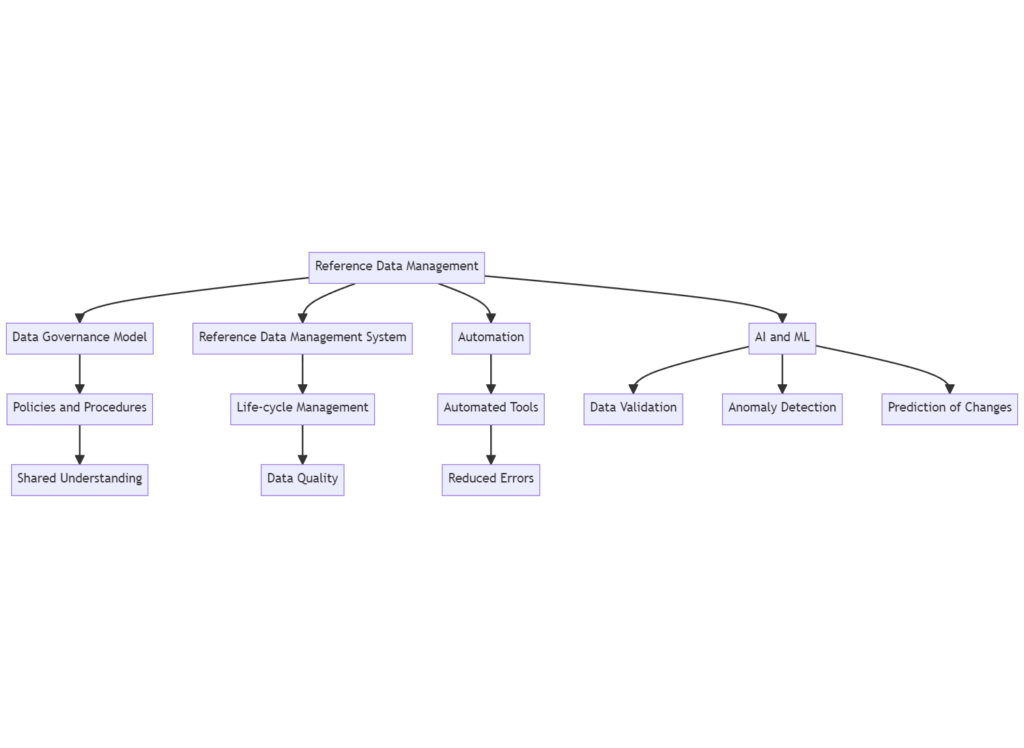
Figure: An effective strategy for reference data management.
The Bottom Line on Reference Data
Reference data is small enough to govern completely and important enough that failing to do so corrupts everything downstream — a rare combination that makes it one of the highest-ROI starting points in a governance program. Separate it conceptually from master data, manage external standards by version and internal codes by change control, drag your crosswalks out of the ETL code and into governed daylight, and give every list an owner. If you’re sequencing a broader program, the free maturity assessment will show you where reference data discipline sits among your other gaps — it’s usually the cheapest one to close.
Frequently Asked Questions About Reference Data
What is reference data in simple terms?
The lists of allowed values used to classify other data: country codes, currency codes, status values, category schemes. It’s the shared vocabulary that lets systems, reports, and teams mean the same thing by the same code.
What is the difference between reference data and master data?
Master data describes business entities — this customer, this product — each an identifiable real-world thing. Reference data is the classification vocabulary those entities use — the valid countries, statuses, and categories. Master data rows get deduplicated and mastered; reference data rows get defined and approved.
What are common examples of reference data?
External standards like ISO 3166 country codes and ISO 4217 currency codes, industry and regulatory classification schemes, plus internal vocabularies: customer status values, product category hierarchies, organizational units, priority scales, and the crosswalk tables that map codes between systems.
Who should own reference data?
Each reference set gets a business owner accountable for its content and definitions, with stewards operating the change process. Sets used across multiple domains — a shared region scheme, an enterprise status model — need explicit cross-domain ownership, with the governance council as the arbiter when domains disagree.
How often does reference data change?
Slowly but not never — which is exactly the trap. External standards update on their publishers’ schedules; internal codes change with reorganizations and new business models. Because changes are rare, organizations skip building a change process, and then a rare change propagates inconsistently and breaks joins and reports for months.
Do I need a dedicated reference data management system?
Not necessarily. Governed tables, a lightweight approval workflow, and single-source distribution deliver most of the value. Dedicated RDM capability (often an MDM platform module) earns its cost when you need version management of external standards, effective-dated history, hierarchy management, or automated drift detection across many consumers.
What is a crosswalk in data management?
A mapping table that translates equivalent codes between systems — the ERP’s US to the legacy system’s 840. Crosswalks are reference data themselves and deserve the same ownership and change control; unmanaged crosswalks buried in ETL code are among the most common silent sources of cross-system data errors.
Why does reference data matter for compliance?
Regulatory reporting largely consists of mapping internal codes to regulator-defined code sets, and privacy and classification regimes depend on consistent categorization of data. Stale or inconsistent reference data turns into misfiled reports and misapplied controls — failures that surface at audit time, long after the drift began.